


What is Megaesophagus?
Megaesophagus is a disease affecting Friesian horses that involves abnormal esophageal function and, in many cases, chronic esophageal dilation. The prevalence of the disease within the breed and the young age at which some Friesians are affected strongly suggest a genetic component.
Megaesophagus appears to vary considerably in both severity and presentation. Early symptoms may be very mild and difficult for owners to recognize. While some horses develop obvious esophageal dilation, others may have more subtle or localized dysfunction that can be challenging to diagnose. The thoracic portion of the esophagus is most commonly affected, particularly near the thoracic inlet, although other regions of the esophagus may also be involved.
If the disease progresses unnoticed, serious complications can occur, including esophageal ulceration, strictures, perforation, aspiration pneumonia, and rupture.
Unfortunately, there is currently no cure or medication capable of reversing the disease process. Dietary and feeding management remain the most effective supportive approaches.
Ongoing research supported by the Fenway Foundation suggests the disease is likely complex and may involve multiple genetic and physiological factors, including abnormalities affecting connective tissue and esophageal function.
If your Friesian horse has been diagnosed with megaesophagus or you suspect they may be affected, please consider supporting our research by submitting a DNA sample using the link below.
Connective Tissue

Structure of the esophagus

Most Friesians are affected in the thoracic region of the esophagus

Flehmen-like response

Latherin (white foam) while eating

Choke with reflux

Grazing reflux
Symptoms of Megaesophagus
-
Repeated episodes of choke
-
Hypersalivation (drool)
-
Aspiration pneumonia
-
Difficulty swallowing
-
Weight loss
-
Ulcers
-
Rolling
-
Pawing
-
Bad breath
-
Head shaking
-
Teeth grinding
-
Excess mucous
-
Nasal discharge
-
Teeth chomping
-
Excessive licking
-
Refusing feed or hay
-
Sticking tongue out
-
Colic-like symptoms
-
Moving tongue around
-
Standing with head down
-
Heavy/labored breathing
-
Lowering or extending the neck
-
Appearing anxious or nervous
-
Standing alone, unusually quiet
-
Repeated coughing or snorting
-
Milk coming out the nose in foals
-
Dramatic coughing during exercise
-
White foam around or in the mouth
-
Gurgling or gagging noises while eating
-
Repeated lowering and raising of the head
-
Loss of pigmentation on the edge of the mouth
-
Standing stretched out with head high in the air
-
Throat clearing or pop-like noise when swallowing
-
Standing with front legs spread wider than normal
-
Flehmen-like response (lifting/curling upper lip)
-
Excessive coughing, sneezing, or saliva while exercising
-
Wave-like motion of the esophagus while swallowing
-
Visible firm bulge of the esophagus near the base of the chest
-
Profuse reflux of feed material through the mouth and/or nose
Diagnosing Megaesophagus
Megaesophagus and other forms of esophageal dysfunction in Friesian horses are most commonly evaluated using a combination of esophagoscopy and a barium swallow study.
Esophagoscopy
An esophagoscopy is an examination of the esophagus using a thin, flexible scope equipped with a light and camera. This procedure allows a veterinarian to visualize the esophagus and evaluate for abnormalities such as dilation, poor motility, inflammation, ulceration, strictures, diverticula, or retained feed material.
One limitation of esophagoscopy is that interpretation can be somewhat subjective and depends heavily on the experience of the veterinarian performing the procedure. In some cases, abnormalities may be subtle, localized, or intermittent. The Fenway Foundation has documented multiple cases in which Friesian horses were initially considered normal following esophagoscopy but were later found to have significant abnormalities during a barium swallow study or later in the course of disease progression.
Barium Swallow Study
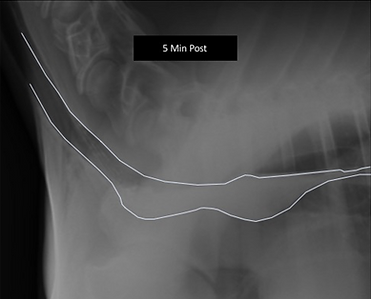
A barium swallow study is one of the most useful tools for evaluating esophageal function and motility. During the procedure, the horse is given liquid barium orally, which coats the esophagus and becomes visible on radiographs. This allows veterinarians to evaluate swallowing function, esophageal clearance, motility abnormalities, and areas of dilation or narrowing.
In some Friesian horses, a barium swallow study may identify abnormalities that are not readily apparent during esophagoscopy alone.
Recommendations
The Fenway Foundation currently recommends performing both an esophagoscopy and a barium swallow study whenever possible, as the two procedures provide complementary information. Esophagoscopy allows direct visualization of the esophageal tissue and potential complications, while a barium swallow study provides important information about esophageal function and motility.
It is also important to recognize that esophageal disease in Friesian horses may vary considerably in severity and presentation. Some horses may have subtle or difficult-to-detect abnormalities, particularly in earlier stages of disease. As research evolves, our understanding of esophageal dysfunction in Friesians continues to expand beyond visible dilation alone.
Images from a esophagoscopy

Images from a barium swallow study



Managing
Megaesophagus
Below are Fenway's basic diet recommendations for horses with megaesophagus. Depending on the severity of a horse's disease and complications (esophageal diverticula, esophageal ulcers, esophageal strictures, esophagitis, etc.), they may require a more restrictive diet.
While the prognosis is typically poor from a veterinary standpoint, many horses with megaesophagus lead full, productive lives when appropriately managed and can still be ridden or driven. We assist owners worldwide with diet advice and recommendations for horses with megaesophagus, based on our experience managing these horses. Please reach out to us if you would like a free consult.
To learn how we manage our Friesians with megaesophagus at Fenway, listen to the podcast episode below.


Community Support

For more information or community support, please join our Facebook support group, Friesians with Megaesophagus.